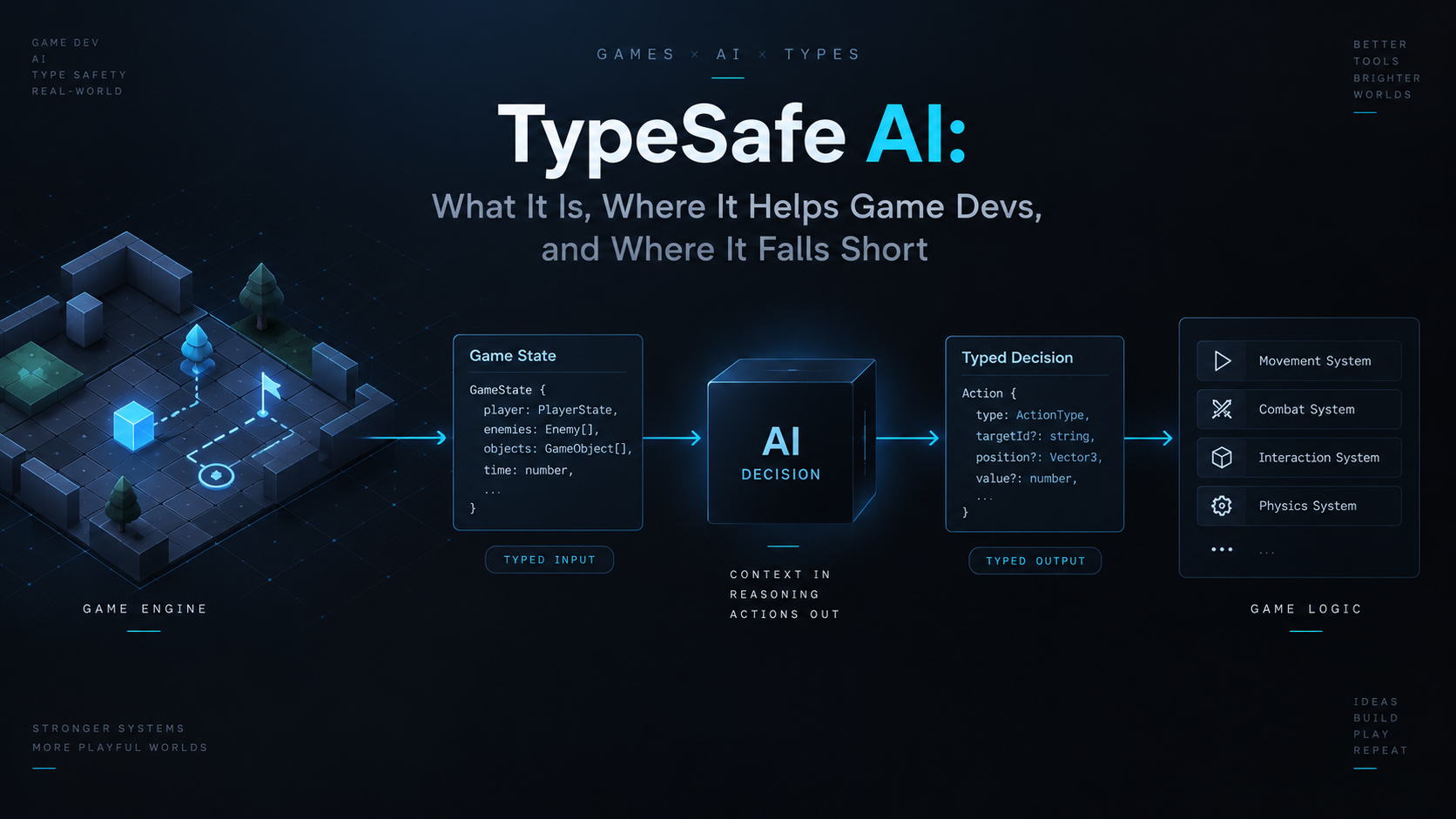
I’ve been looking at TypeSafe AI and trying to understand where it actually fits into modern game development. The name can be misleading: TypeSafe AI is not primarily a framework for making LLMs generate type-safe code.
Its core idea is different.
TypeSafe is building a class of models called System One Models, designed to make fast, structured decisions that software can consume directly. Its first public model, Jev, takes application state plus typed questions and returns structured answers such as classifications, scores, probabilities, and confidence instead of generating free-form text.
That distinction is important.
A conventional LLM workflow looks roughly like this:
Game state
   ↓
LLM
   ↓
Generated text / JSON
   ↓
Parse
   ↓
Validate
   ↓
Application logic
TypeSafe is aiming for something closer to:
Game state
   ↓
Jev
   ↓
Typed decision
   ↓
Game code
The model is not being asked to write the next system or generate a chunk of gameplay code. Instead, it acts more like an intelligent function inside the game or game backend.
What exactly is TypeSafe AI?
TypeSafe describes this as Machine Native Intelligence: AI designed to interact with software rather than primarily with humans. Its premise is that production automation needs properties such as structure, reliability, observability, testability, consistency, speed, and low cost.
Jev’s interface is built around three primitives:
Choice
  "Which option?"

Score
  "How strongly does this apply?"

Noul
  "Is this statement true?"
A Choice returns a selected option together with probabilities and confidence.
A Score evaluates the state against an ordered rubric and returns a score, probabilities, and confidence.
A Noul returns a value between 0 and 1, representing the probability that a statement is true.
For example, a game could send:
{
  "player_health": 23,
  "enemy_distance": 8,
  "ammo": 2,
  "near_cover": true,
  "recent_damage": 47
}
and ask:
Choice:
"What should the enemy do next?"

Options:
- attack
- retreat
- seek_cover
- reposition
The important part is that the application defines the possible decisions. The AI isn’t inventing arbitrary commands.
Your code can then do:
decision = response.answers["enemy_action"]

if decision.choice == "attack":
    attack()

elif decision.choice == "retreat":
    retreat()

elif decision.choice == "seek_cover":
    find_cover()

elif decision.choice == "reposition":
    reposition()
The model provides the semantic judgment. Your program still owns the control flow.
That is the central TypeSafe idea.
Why is this different from normal LLM structured output?
At first glance, this can look like ordinary JSON mode.
It isn’t quite the same idea.
With a conventional LLM, you might prompt:
Return JSON:

{
  "action": "attack | retreat | seek_cover"
}
The model is still fundamentally generating text. Your application has to parse and validate that output.
TypeSafe’s interface is designed around typed decisions from the beginning. Its documentation describes the answers as constrained to the options or levels supplied by the application, rather than recovering those values from generated prose.
There is another important difference: probability and confidence are first-class outputs.
For example:
{
  "choice": "seek_cover",
  "probabilities": {
    "attack": 0.08,
    "retreat": 0.17,
    "seek_cover": 0.71,
    "reposition": 0.04
  },
  "confidence": 0.84
}
That gives the game a way to make uncertainty part of the architecture.
Instead of:
if ai_says_attack:
    attack()
you can build:
if confidence < 0.6:
    use_fallback_behavior()

elif action == "attack":
    attack()
TypeSafe explicitly recommends using confidence to determine whether software should act automatically, proceed cautiously, or escalate to another system or a human. The appropriate threshold depends on the risk and application.
Where TypeSafe AI could actually help game developers
TypeSafe’s documentation explicitly lists gaming as a use case. It suggests applications including evaluating player reports, moderating chat, scoring frustration or engagement, detecting churn signals, and routing player-support requests. It also identifies real-time applications as a target because the model is designed for low-latency decision making.
But the concept extends beyond moderation.
1. NPC decision making
This is probably one of the most interesting applications.
Traditional NPC logic often looks like:
if health < 20%
    flee

else if player is nearby
    attack

else if heard_sound
    investigate

else
    patrol
This works, but every new behavioral condition adds more hand-written rules.
A TypeSafe-style system could expose the game state:
{
  "npc": {
    "health": 34,
    "morale": 0.42,
    "weapon": "shotgun"
  },
  "player": {
    "distance": 12,
    "health": 72
  },
  "environment": {
    "cover_available": true,
    "allies_nearby": 2
  }
}
Then ask several focused questions:
Is the NPC currently threatened?

How favorable is the current combat situation?

Which action is most appropriate?

How likely is retreat to improve survival?
These can be decomposed into atomic questions and combined in code. TypeSafe explicitly recommends this style instead of asking one large question that requires the model to reason about everything at once.
The advantage isn’t that the AI magically becomes a complete NPC brain.
The advantage is that semantic judgments can become another input to the existing behavior system.
2. Player intent and adaptive game systems
Games constantly need to infer what a player is doing.
For example:
Is the player exploring?

Are they struggling?

Are they intentionally avoiding combat?

Are they frustrated?

Is the player attempting a speedrun?

Are they likely to quit?
These are difficult to express as traditional deterministic rules.
Instead, telemetry can be converted into a structured state and evaluated with Noul, Score, or Choice.
For example:
Score:
"How frustrated does this player currently appear?"

Levels:
0 = relaxed
1 = mildly frustrated
2 = frustrated
3 = highly frustrated
The game could then combine that with ordinary telemetry:
difficulty_modifier = (
    base_difficulty
    + frustration_score * 0.15
)
This is an important distinction from generative AI.
The model doesn’t need to write a paragraph explaining:
“The player seems somewhat frustrated because…”
The application only needs the decision.
That is exactly the kind of software-oriented interaction TypeSafe is designed around.
3. Dynamic content selection
Games frequently need to choose between many possible pieces of content:
Which quest should appear?

Which dialogue branch is relevant?

Which tutorial should be shown?

Which reward is appropriate?

Which NPC should react?

Which generated asset should be selected?
This maps naturally to Choice and Score.
For example:
Choice:
"Which quest is most relevant to this player's current state?"
with:
combat
exploration
story
crafting
social
Or:
Score:
"How relevant is this quest to the player's recent activity?"
You can then rank hundreds or thousands of candidates instead of asking a general-purpose LLM to generate a complete recommendation.
TypeSafe explicitly describes semantic search, scoring, ranking, retrieval, and candidate selection as intended workflow categories.
4. Multiplayer moderation
This is one of the most straightforward applications.
Consider a multiplayer chat message:
"you are absolute trash uninstall"
The game can send it to TypeSafe and ask several questions in one request:
Is this harassment?

Is this profanity?

Is this targeted abuse?

How severe is it?

Should it be reviewed?
The result can then feed directly into the moderation system:
allow
warn
mute
temporary restriction
human review
This fits TypeSafe’s documented gaming and moderation use cases particularly well. Its examples include toxicity, abuse, suspicious behavior, severity scoring, and routing uncertain cases for review.
And because the questions are independent, several of them can be evaluated together against the same state. TypeSafe calls this kind of architecture speculative fan-out.
5. Game-support automation
A live-service game might receive thousands of support tickets:
"My purchase disappeared."

"My account was hacked."

"I can't access multiplayer."

"My character lost an item."

"I want a refund."

"Someone is cheating."
Instead of building a giant prompt that asks an LLM to “handle the ticket,” TypeSafe’s recommended architecture is closer to:
                 ┌─ Is this a refund request?
                 │
Ticket ──────────┼─ Which issue category?
                 │
                 ├─ How urgent?
                 │
                 ├─ How severe?
                 │
                 └─ Does policy permit automation?
                          │
                          ▼
                     Game backend
Each result becomes a typed piece of state that ordinary application code can use for routing.
This is precisely the kind of decomposed workflow TypeSafe documents.
6. AI-driven real-time game experiments
TypeSafe has actually demonstrated a gaming-related real-time application.
In its September 2026 launch material, the company describes a Doom demo where Jev receives structured game state and makes decisions for a bot. The company notes that the demo is based on structured state containing text rather than visual image input.
That distinction matters.
It means the interesting experiment isn’t:
screen pixels
    ↓
vision model
    ↓
action
but rather:
game engine
    ↓
structured game state
    ↓
Jev
    ↓
decision
    ↓
game engine
That architecture is much easier to integrate into an existing game because the engine already knows things like:
player position
enemy positions
health
ammo
weapons
objectives
doors
cover
map state
The AI doesn’t necessarily need to rediscover this information from pixels.
A better mental model for TypeSafe
One useful way to think about TypeSafe is:
It is closer to an intelligent decision API than an AI coding assistant.
Traditional AI:
Input → LLM → Text
TypeSafe:
State + Question
       ↓
   TypeSafe
       ↓
Typed decision + probability/confidence
Then your application builds the actual behavior:
             ┌───────────────┐
             │ Game State    │
             └───────┬───────┘
                     │
                     ▼
             ┌───────────────┐
             │    TypeSafe   │
             └───────┬───────┘
                     │
           ┌─────────┼─────────┐
           ▼         ▼         ▼
        Choice     Score     Noul
           │         │         │
           └─────────┼─────────┘
                     ▼
             ┌───────────────┐
             │ Game Logic    │
             │ / AI / Rules  │
             └───────────────┘
This fits TypeSafe’s documented architecture: AI handles semantic judgments, while code retains control of the system’s control flow.
Where TypeSafe AI falls short
This is where the original idea needs the most correction.
TypeSafe’s type safety does not mean that the AI is always correct.
It means the model produces outputs within the decision structure you gave it.
Those are very different guarantees.
Suppose you ask:
Choice:
"Which weapon should the player use?"
and provide:
pistol
shotgun
rifle
The model can return:
shotgun
with a perfectly valid typed answer.
That does not prove shotgun is actually the optimal weapon.
The schema can guarantee:
"shotgun" is a valid output
It cannot guarantee:
"shotgun" is strategically correct
That distinction is fundamental.
TypeSafe itself acknowledges that Jev can still get things wrong; its claim is that the model’s outputs are structurally constrained and accompanied by uncertainty, not that semantic errors become impossible.
1. It does not replace deterministic game logic
You still need ordinary game programming.
Physics:
collision detection
movement integration
rigid-body simulation
animation
rendering
network synchronization
should not suddenly become “ask the AI.”
For example, an AI might decide:
jump
but the game engine still needs to determine:
Can the character actually jump?

Is the character grounded?

What impulse should be applied?

Does this violate the game's movement rules?
TypeSafe is most useful where the problem is semantic uncertainty, not where deterministic computation already solves the problem.
2. It is not a code-generation system
This is probably the biggest correction to the original article.
TypeSafe AI is not:
Define TypeScript interface
      ↓
LLM
      ↓
Generate implementation
      ↓
tsc
That is a separate software-engineering pattern.
TypeSafe is instead:
Define decision
      ↓
Jev
      ↓
Typed result
      ↓
Your code
So TypeSafe should not be described as a replacement for:
ts-morph
Zod
zod-to-ts
Rust types
tsc
compiler-in-the-loop agents
Those technologies can still be useful alongside TypeSafe, but they solve a different problem.
3. Confidence is not certainty
This is another important caveat.
Suppose TypeSafe returns:
{
  "choice": "attack",
  "confidence": 0.96
}
That does not mean:
96% chance this particular answer is correct
in a guaranteed per-decision sense.
TypeSafe describes calibration statistically: over many predictions, probabilities should correspond to observed frequencies. Its documentation explicitly notes that calibration describes groups of predictions, not a guarantee for an individual answer.
So production systems still need:
evaluation
threshold tuning
fallbacks
monitoring
domain-specific testing
The confidence signal is useful; it isn’t magic.
4. Game state still has to be modeled correctly
AI cannot reason about information you never provide.
If the game sends:
{
  "health": 20,
  "ammo": 3
}
but doesn’t include:
nearby cover
enemy count
objective
weapon type
line of sight
team composition
then those factors cannot influence the decision.
This pushes complexity into state design.
For game developers, that can become one of the biggest engineering challenges:
What state should the model see?

How frequently should it be updated?

Which values matter?

How much context is enough?

Which information should stay deterministic?
The quality of the overall system therefore depends heavily on the game-side representation of state.
5. Latency does not mean “AI every frame”
TypeSafe is explicitly targeting fast inference and real-time applications. Its public material reports roughly 70–500 ms end-to-end response times depending on the call, while its use-case documentation describes real-time applications around 150 ms.
That is fast compared with many frontier LLM workflows.
But 150 ms is still nowhere near a 60 FPS game frame:
60 FPS = 16.67 ms/frame
So the sensible architecture is not:
render frame
   ↓
call AI
   ↓
wait
   ↓
render next frame
Instead, it is more likely to be used asynchronously for things like:
NPC strategic decisions
player intent
content selection
moderation
difficulty adaptation
event-driven behaviors
The deterministic game loop remains responsible for the frame-by-frame work.
6. Early access means production maturity is still being established
Jev is currently presented by TypeSafe as an early-access model. TypeSafe is actively publishing new workflows, evaluations, and examples while developers experiment with the system.
That means questions still need to be answered through real deployments:
How stable are results over long periods?

How well does it generalize to unusual game states?

How does it behave under distribution shift?

How should confidence thresholds be calibrated for each game?

How much state can be supplied before quality degrades?

How should failures be monitored?
Those are engineering questions that a demo cannot fully answer.
The more interesting architecture
The biggest idea behind TypeSafe isn’t “replace game developers with AI.”
It is closer to:
Move AI from the role of an autonomous text generator into the role of a typed decision component inside conventional software.
That results in an architecture like:
                 GAME
                   │
          ┌────────▼────────┐
          │ Deterministic   │
          │ Game Systems    │
          └────────┬────────┘
                   │
             structured state
                   │
                   ▼
          ┌─────────────────┐
          │    TypeSafe     │
          │      Jev        │
          └────────┬────────┘
                   │
          ┌────────┼─────────┐
          │        │         │
       Choice    Score      Noul
          │        │         │
          └────────┼─────────┘
                   │
            probabilities
            + confidence
                   │
                   ▼
          ┌─────────────────┐
          │ Game code / AI  │
          │ behavior system │
          └─────────────────┘
That is fundamentally different from putting a chatbot inside the game.
The game remains deterministic where determinism matters.
The AI is introduced specifically where semantic judgment is difficult to encode with ordinary rules.
Final take
TypeSafe AI is best understood as a machine-oriented decision layer.
It is not primarily about:
AI writes code
It is about:
AI makes a structured judgment
        ↓
software consumes that judgment
        ↓
ordinary code decides what happens next
For game development, that makes it interesting for problems such as NPC decisions, moderation, player-intent detection, dynamic content selection, support automation, ranking, and other places where the game needs to interpret messy or ambiguous information.
The real value is not simply that the output is “typed.”
It is that the decision itself becomes an explicit software interface:
question
→ constrained answer
→ probabilities
→ confidence
→ application logic
That can make AI easier to compose into larger systems than treating an LLM as a black-box text generator.
But it does not eliminate the hard parts of game AI. You still need good state representations, deterministic game systems, evaluation, fallbacks, testing, and domain-specific logic.
In other words:
TypeSafe doesn’t make AI magically correct. It makes AI decisions easier for software to consume, constrain, observe, and compose.
That distinction is where the interesting engineering work begins.